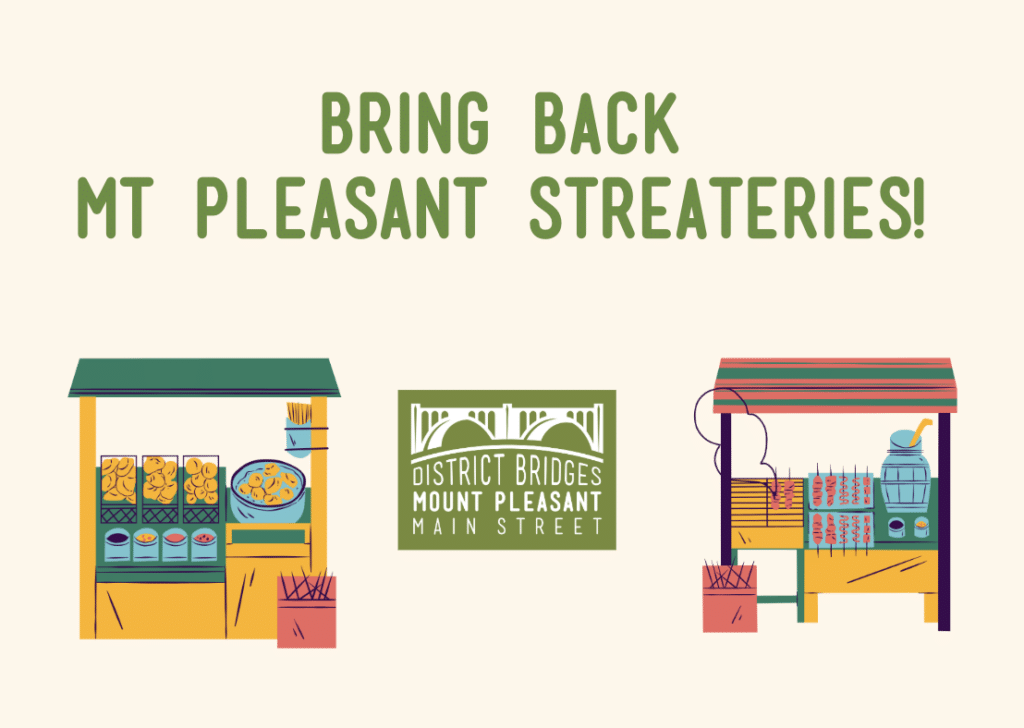
Walk down Mt. Pleasant Street on a warm evening and it’s easy to understand why people love this neighborhood. Known as the “village in the city,” you’re likely to run into a neighbor before you make it half a block. It’s a vibrant, historic corridor lined with independent shops and restaurants, where people are always out enjoying the scene. Streateries have deepened that energy, extending the sidewalk life that makes Mount Pleasant such a lively gathering place. For most local businesses, those curbside tables aren’t just atmosphere; they’re a meaningful part of staying afloat. On any given night, those extra tables mean another server shift, another family served, another business staying open.
Streateries have proven to be a vital addition across DC. After the temporary pandemic-era program was launched, 87 percent of small businesses with streateries reported a revenue increase of 34 percent on average. An overwhelming 89 percent of streatery permit holders supported making the streatery program permanent. Outdoor dining turns a parking space generating roughly $8,400 a year in meter revenue for the city into something that generates many times that in meals, wages, and tax revenue. This is especially true for Mount Pleasant, where there are no paid parking meters.
The temporary streatery program officially expired in November 2025, and DC’s Department of Transportation (DDOT) has introduced new standardized codes aimed at making streateries safer, more accessible, and more attractive. But most existing streateries across the city don’t meet the new requirements. That means the structures that neighbors have come to love, and restaurants rely on, must be torn down and rebuilt to code. For businesses already stretched thin, that’s another significant cost on top of an already unclear process. Hiring an architect to help with the complicated permitting is cost-prohibitive, especially for the kind of small, independent restaurants that define a neighborhood like Mount Pleasant.
The Cost of Going It Alone
Keeping streateries has become an increasingly difficult calculation for our businesses. A streatery isn’t just a structure: it requires a design permit, a building permit through the Department of Buildings, and sometimes a block permit and sidewalk café permit on top of those. Each comes with its own timeline, fees, and requirements. For restaurants, which already operate on thin margins, the total cost is often out of reach. Permitting alone can reach more than $10,000 with an architect before any structure is built.
Businesses such as Marx Cafe, La Tejana, Ellē, Joia Burger, Suns Cinema, and Beau Thai all had streateries, but have found the costs of making them permanent too high. So now they don’t—not because they don’t want to, but because the system makes it too expensive to try. Other businesses, like Purple Patch and Martha Dear, are moving forward with the long-term investment, but doing so puts them in a difficult cash position.
The Solution? Collaboration
There’s a solution that changes the math: coordination and shared resources. Instead of each restaurant navigating the full permitting and design process individually, District Bridges is working with architects to develop plans that can be adapted across multiple businesses. This approach helps reduce upfront costs and simplifies a complex process, making it more feasible for small businesses to participate. It also creates flexibility for additional businesses on the corridor to opt in over time as they’re ready and as designs are approved. Once the permit exists, individual restaurants can move forward at a cost of roughly $5,000 each for the remaining permits, rather than $10,000 for going it alone, plus the cost of the structure and installation.
The fundraising now under way is aimed at covering the next stages: architectural design, permitting, and eventually the construction of streatery units for the businesses ready to move forward.
Why It Matters
DC’s streatery program was always supposed to be temporary. What it revealed, though, is lasting: that outdoor dining is good for restaurants, good for streets, and good for the neighborhoods built around them. The challenge now is making it accessible to the businesses that don’t have the capital to absorb a $20k+ cost on their own. Mount Pleasant has always been a place where people take care of their own, and this is a chance for neighbors to do the same for the businesses that make this “village” so special.
👉Donate today to help bring streateries back to Mount Pleasant while supporting the small businesses that make our neighborhood feel like home. Your donation covers architecture support, permitting fees, and construction costs.
Typical costs are below:
- Cost for architectural drawings – $3000 per business
- Cost for permit support – $2500 per business
- Cost for construction – $10,000 per business